Image copyright Nature Neuroscience
Long-term labeling and imaging of synaptically connected neuronal networks in vivo using double-deletion-mutant rabies viruses
Published in Nat Neuroci.
Authors
Lei Jin, Heather A Sullivan, Mulangma Zhu, Thomas K Lavin, Makoto Matsuyama, Xin Fu, Nicholas E Lea, Ran Xu, YuanYuan Hou, Luca Rutigliani, Maxwell Pruner, Kelsey R Babcock, Jacque Pak Kan Ip, Ming Hu, Tanya L Daigle, Hongkui Zeng, Mriganka Sur, Guoping Feng, Ian R Wickersham
Paper presented by Dr. Elliot Glotfelty and selected by the NIDA TDI Paper of the Month Committee
Publication Brief Description
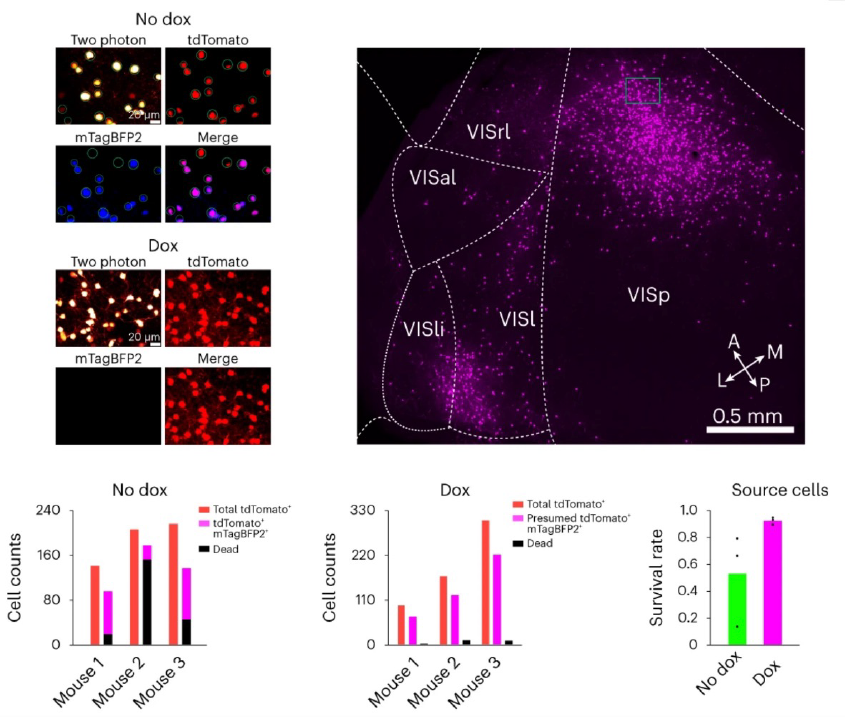
This study addresses the major limitations of previous monosynaptic tracing methods using rabies virus, which caused severe cytotoxicity and prevented long-term in vivo analysis of neural circuits. To overcome this limitation, the researchers developed a second-generation, low-toxicity system by employing a double-deletion-mutant rabies virus that lacks both the glycoprotein (G) and the viral polymerase gene L (RABVgp5), combined with a doxycycline-suppression mechanism to halt viral replication. This novel approach drastically reduces viral load and cellular damage, enabling successful longitudinal imaging of synaptically connected neuronal networks. The system proved highly effective, demonstrating that over 90% of the labeled neurons survived for a full 12 weeks and maintained normal visual response properties for at least 10 weeks. Consequently, this technology provides a robust tool for long-term functional studies of neural circuit development, plasticity, and disease in vivo.
Long-term labeling and imaging of synaptically connected neuronal networks in vivo using double-deletion-mutant rabies viruses Journal Article
In: Nat Neurosci, vol. 27, no. 2, pp. 373–383, 2024, ISSN: 1546-1726.
