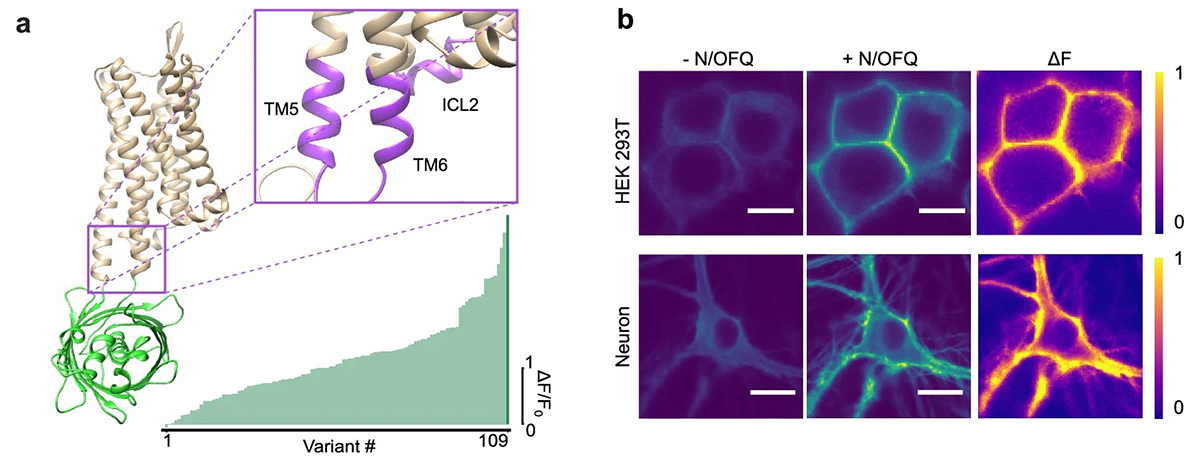
A figure from this article. Image copyright Nat Comm.
Development of a genetically encoded sensor for probing endogenous nociceptin opioid peptide release
Published in Nat Comm.
Authors
Xuehan Zhou, Carrie Stine, Patricia Oliveira Prada, Debora Fusca, Kevin Assoumou, Jan Dernic, Musadiq A Bhat, Ananya S Achanta, Joseph C Johnson, Amanda Loren Pasqualini, Sanjana Jadhav, Corinna A Bauder, Lukas Steuernagel, Luca Ravotto, Dietmar Benke, Bruno Weber, Azra Suko, Richard D Palmiter, Miriam Stoeber, Peter Kloppenburg, Jens C Brüning, Michael R Bruchas, Tommaso Patriarchi
Paper presented by Dr. Agnieszka Sulima and selected by the NIDA TDI Paper of the Month Committee
Publication Brief Description
The nociceptin/orphanin FQ (N/OFQ) opioid peptide and its receptor (NOPR) are critical regulators of motivation, stress, feeding, and sleep, and growing evidence identifies the NOP receptor as a promising target for the treatment of addiction, insomnia, and depression. However, studying the dynamics of the N/OFQ-NOPR peptide system has been challenging due to limitations in existing detection methods.
The research groups led by Michael R. Bruchas and Tommaso Patriarchi developed NOPLight by engineering a human NOPR-based fluorescent sensor with high ligand selectivity, subsecond activation kinetics, and minimal interference with cellular signaling. NOPLight was validated in HEK293T cells, neurons, brain slices, and freely moving mice, demonstrating its ability to detect both exogenous NOPR agonists and endogenous N/OFQ release during behaviors like reward-seeking, aversion, and feeding. This sensor provides a powerful tool for investigating neuropeptide signaling and its role in neural circuits and behavior.
Development of a genetically encoded sensor for probing endogenous nociceptin opioid peptide release Journal Article
In: Nat Commun, vol. 15, no. 1, pp. 5353, 2024, ISSN: 2041-1723.
