Featured Paper of the Month – July 2026
Published in Molecular Psychiatry by Omar Soler-Cedeño and Zheng-Xiong Xi, et al. of the NIDA IRP Addiction Biology Unit.
Summary
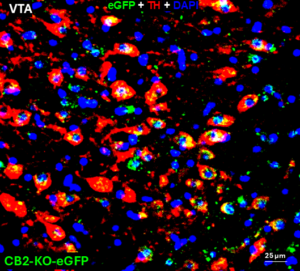
This study tested a novel compound, MRI-2594, to determine whether it could reduce opioid use and relapse-related behaviors in rats and mice. The drug works by activating the cannabinoid CB2 receptor, which is not responsible for the psychoactive “high” associated with cannabis. Animals treated with MRI-2594 self-administered less heroin and were less likely to resume heroin-seeking after a period of abstinence. The drug also reduced dopamine neuron activity and dopamine release in the mesolimbic reward system. Importantly, these effects were absent in CB2 knockout mice, in which the CB2 gene was replaced with a GFP reporter that can be visualized in midbrain dopamine neurons. These findings provide strong evidence that CB2 receptors, including those expressed in dopamine neurons, contribute at least in part to the drug’s therapeutic effects. MRI-2594 did not cause sedation, impair movement, or interfere with the pain-relieving effects of opioids. It even produced mild analgesic effects on its own. Although these findings are promising, the research was conducted only in animals. Further studies are needed to determine whether CB2-targeting drugs such as MRI-2594 can safely and effectively treat opioid use disorder in humans.
Publication Information
Brain CB2 receptor: a new target in medication development for treating opioid use disorder in rodents Journal Article
In: Mol Psychiatry, vol. 31, no. 4, pp. 2351–2364, 2026, ISSN: 1476-5578.
