Hot Off the Press – October 1, 2026
Published in Nature Communications by Eun-Kyung Hwang and Carl Lupica, et al. of the NIDA IRP Electrophysiology Research Section.
Summary
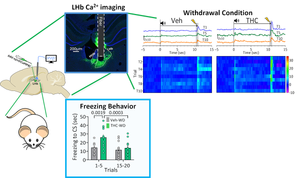
Withdrawal from many abused drugs results in negative emotional states such as anxiety, depression, and increased aversion to some environmental stimuli. Also, avoiding these negative emotional states through continued drug use represents an obstacle to drug abstinence. Although withdrawal-associated negative states are well-understood for drugs like cocaine, nicotine, and opiates, much less is known about changes in brain function during withdrawal from cannabis. Here, NIDA researchers investigated how withdrawal from repeated exposure to the main psychoactive component of cannabis, known as delta-9-tetrahydrocannabinol (THC), changes brain activity and behavior when unpleasant experiences are encountered. In rats withdrawn from THC, neurons in the lateral habenula (LHb)—a brain region involved in processing negative experiences—responded more strongly to mild foot shock and developed a stronger learned fear response, known as freezing, to a tone that was paired with the shock.
To explain the increased LHb response that was observed during THC withdrawal, NIDA researchers measured synaptic inhibition of LHb neurons and found that it was impaired for up to 30 days after THC withdrawal. This loss of inhibition shifted the balance of LHb neuron activity toward increased excitability.
The findings suggest that repeated use of cannabis can produce lasting changes in a brain circuit that processes unpleasant experiences, potentially contributing to heightened negative emotional states during withdrawal. Additionally, the study identifies a synaptic mechanism through which this occurs. Because the study was conducted in rats, it does not conclusively establish that the same mechanism is involved in cannabis withdrawal symptoms in people. Thus, further research is needed to determine whether this brain region could eventually be a target for treating cannabis withdrawal and cannabis use disorder in humans.
Publication Information
Increased encoding of aversive stimuli by lateral habenula neurons during Δ9-tetrahydrocannabinol withdrawal Journal Article
In: Nature Communications, 2026, ISBN: 2041-1723.
