Reviews To Read – August 2026
Published in Medicinal Research Reviews by Amy Newman, Scientific Director of the NIDA IRP.
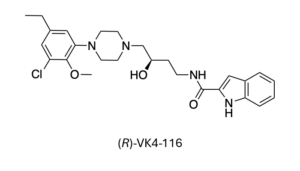
NIDA-IRP Researchers are developing (R)-VK4-116 as a possible non-opioid medication for opioid use disorder. Unlike methadone, buprenorphine, and naltrexone, which act on opioid receptors, (R)-VK4-116 blocks the dopamine D3 receptor. This receptor is concentrated in brain regions involved in reward, motivation, and responses to drug-related cues, making it a potential target for reducing drug use and relapse without directly affecting opioid receptors.
Studies in rodents found that VK4-116 reduced oxycodone use and drug-seeking behavior, as well as increased pain sensitivity and irritability-like behavior during opioid withdrawal. Importantly, it did not interfere with opioids’ pain-relieving effects and may enhance them. The compound also reversed some cognitive problems caused by long-term cocaine exposure in rats and did not worsen the cardiovascular effects of oxycodone or cocaine in preclinical testing.
The more active enantiomer, (R)-VK4-116, was selected for further development. Safety studies identified doses suitable for initial testing in people and found no major safety concerns under the conditions studied. The Food and Drug Administration cleared the compound in 2025 to begin a first-in-human clinical study. Whether (R)-VK4-116 is safe and effective for treating opioid use disorder in people remains to be determined in clinical trials.
Developing the Dopamine D3 Receptor (D3R) Antagonist, (R)-VK4-116, as a Non-Opioid Medication for the Treatment of Opioid Use Disorder Journal Article
In: Med Res Rev, 2026, ISSN: 1098-1128.
