• Skip to primary navigation
  • Skip to main content
  • Skip to primary sidebar

NIDA IRP

National Institute on Drug Abuse - Intramural Research Program

  National Institute on Drug Abuse | NIH IRP | Treatment Info | Emergency Contacts
  • Home
  • News
    • Featured Paper of the Month
    • Reviews to Read
    • Hot off the Press
    • IRP News
    • Awards
    • Technology Resources Initiative Paper of the Month
    • Seminar Series
    • Addiction Grand Rounds
  • About
    • About NIDA IRP
    • Contact Us
    • Directions and Map
    • Careers at NIDA IRP
    • Emergency Contacts
    • Employee Assistance Resources
  • Organization
    • Faculty
    • Office of the Scientific Director
    • Office of the Clinical Director
    • Office of Education and Career Development
    • Administrative Management Branch
    • Molecular Targets and Medications Discovery Branch
    • Cellular and Neurocomputational Systems Branch
    • Molecular Neuropsychiatry Research Branch
    • Neuroimaging Research Branch
    • Behavioral Neuroscience Research Branch
    • Integrative Neuroscience Research Branch
    • Translational Addiction Medicine Branch
    • Core Facilities
    • Community Outreach Group
  • Training Programs
    • Office of Education and Career Development
    • OECD Awards
    • Summer Internship Program
    • Postbaccalaureate Program
    • Graduate Partnership Program
    • Postdoctoral Program
    • NIDA Speakers Bureau
    • Clinical Electives Program
  • Study Volunteers
  • TRI Home
  • TRI Paper of the Month
  • TRI Seminar Series
  • Resources
  • Staff
  • TDI Paper of the Month Committee
  • Technology Transfer
  • Transgenic Rat Project
  • Equipment Inventory Database
    (NIDA Staff Only, VPN Required)

Technology Resource Initiative – Paper of the Month – December 2025

Twice-Yearly Lenacapavir or Daily F/TAF for HIV Prevention in Cisgender Women

Published in The New England Journal of Medicine.

Authors

Linda-Gail Bekker, Moupali Das, Quarraisha Abdool Karim, Khatija Ahmed, Joanne Batting, William Brumskine, Katherine Gill, Ishana Harkoo, Manjeetha Jaggernath, Godfrey Kigozi, Noah Kiwanuka, Philip Kotze, Limakatso Lebina, Cheryl E Louw, Moelo Malahleha, Mmatsie Manentsa, Leila E Mansoor, Dhayendre Moodley, Vimla Naicker, Logashvari Naidoo, Megeshinee Naidoo, Gonasagrie Nair, Nkosiphile Ndlovu, Thesla Palanee-Phillips, Ravindre Panchia, Saresha Pillay, Disebo Potloane, Pearl Selepe, Nishanta Singh, Yashna Singh, Elizabeth Spooner, Amy M Ward, Zwelethu Zwane, Ramin Ebrahimi, Yang Zhao, Alexander Kintu, Chris Deaton, Christoph C Carter, Jared M Baeten, Flavia Matovu Kiweewa; PURPOSE 1 Study Team

Paper presented by Elliot Glotfelty, Ph.D. and selected by the NIDA TDI Paper of the Month Committee
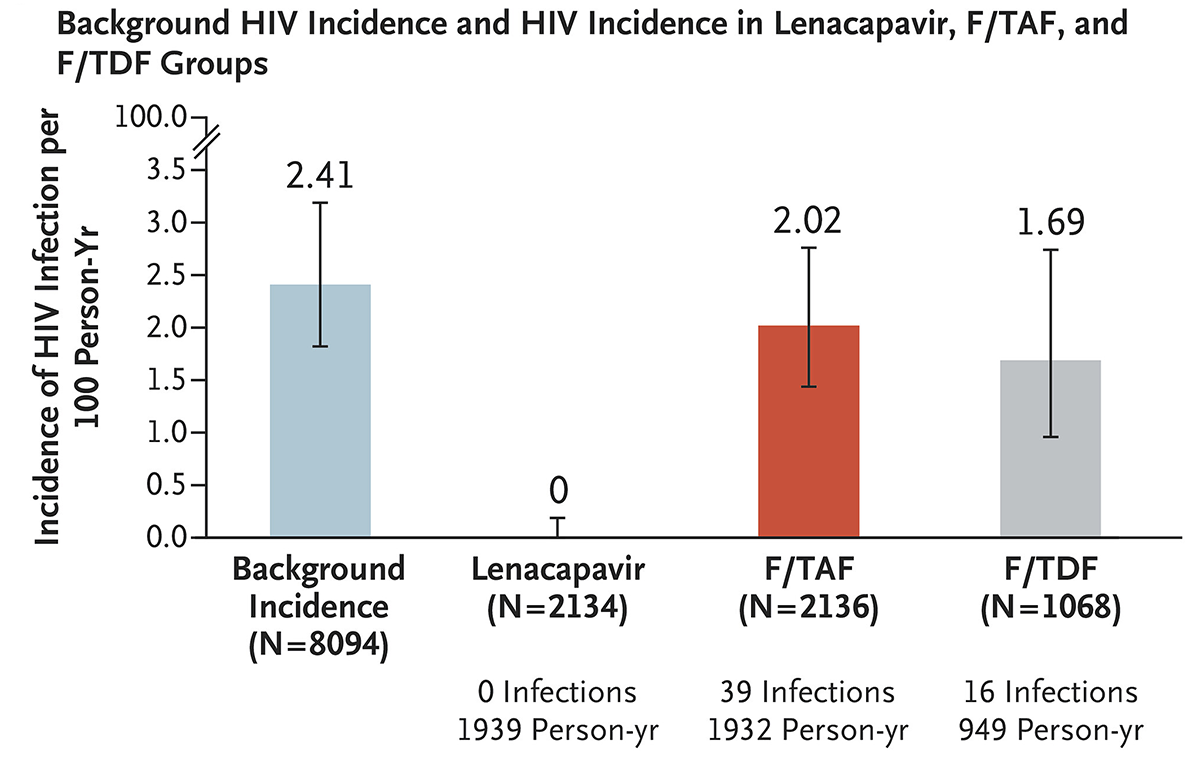
A portion of a figure from this study. Image Copyright New England Journal of Medicine

A portion of a figure from this study. Image Copyright New England Journal of Medicine


Publication Brief Description

Patient adherence to a daily medication regimen is consistently one of the barriers to effective disease prevention and treatment. Current Food and Drug Administration (FDA) treatments/prophylactics for human immunodeficiency virus (HIV) require daily oral administration of medication to effectively prevent or quell HIV infection. A high risk population for HIV transmission includes those who inject illicit drugs, among other high risk behaviors, representing a subpopulation that could benefit from HIV harm reduction strategies that do not require daily oral medication. Bekker et al. (2024) presents a two-year phase 3, double blind, randomized, control trial involving adolescent girls and young women in South Africa and Uganda receiving either subcutaneous lenacapavir every 26 weeks, daily oral emtricitabine-tenofovir alafenamide (F/TAF), or daily oral emtricitabine-tenofovir disoproxil fumarate (F/TDF; active control). F/TAF and F/TDF are FDA approved preexposure prophylaxis (PrEP) antiretroviral drugs that require strict adherence to daily oral administration; lenacapavir is a novel, first in class, multistage HIV-1 capsid inhibitor with high potency and a long half-life allowing for twice yearly subcutaneous injection to maintain active drug bioavailability. All participants in this clinical trial were HIV-negative at the start of the study and were not receiving PrEP medications. Strikingly, no participants receiving twice-yearly lenacapavir acquired HIV infections, with HIV infections significantly lower than background HIV incidence and HIV incidence within the F/TDF group over the two year trial. Lenacapavir may be an effective harm reduction strategy for populations engaging in high risk behaviors prone to transmitting HIV, such as illicit injectable drug use, and those less likely to adhere to daily oral prophylactics.


Bekker, Linda-Gail; Das, Moupali; Karim, Quarraisha Abdool; Ahmed, Khatija; Batting, Joanne; Brumskine, William; Gill, Katherine; Harkoo, Ishana; Jaggernath, Manjeetha; Kigozi, Godfrey; Kiwanuka, Noah; Kotze, Philip; Lebina, Limakatso; Louw, Cheryl E; Malahleha, Moelo; Manentsa, Mmatsie; Mansoor, Leila E; Moodley, Dhayendre; Naicker, Vimla; Naidoo, Logashvari; Naidoo, Megeshinee; Nair, Gonasagrie; Ndlovu, Nkosiphile; Palanee-Phillips, Thesla; Panchia, Ravindre; Pillay, Saresha; Potloane, Disebo; Selepe, Pearl; Singh, Nishanta; Singh, Yashna; Spooner, Elizabeth; Ward, Amy M; Zwane, Zwelethu; Ebrahimi, Ramin; Zhao, Yang; Kintu, Alexander; Deaton, Chris; Carter, Christoph C; Baeten, Jared M; Kiweewa, Flavia Matovu

Twice-Yearly Lenacapavir or Daily F/TAF for HIV Prevention in Cisgender Women Journal Article

In: N Engl J Med, vol. 391, no. 13, pp. 1179–1192, 2024, ISSN: 1533-4406.

Abstract | Links

@article{pmid39046157,
title = {Twice-Yearly Lenacapavir or Daily F/TAF for HIV Prevention in Cisgender Women},
author = {Linda-Gail Bekker and Moupali Das and Quarraisha Abdool Karim and Khatija Ahmed and Joanne Batting and William Brumskine and Katherine Gill and Ishana Harkoo and Manjeetha Jaggernath and Godfrey Kigozi and Noah Kiwanuka and Philip Kotze and Limakatso Lebina and Cheryl E Louw and Moelo Malahleha and Mmatsie Manentsa and Leila E Mansoor and Dhayendre Moodley and Vimla Naicker and Logashvari Naidoo and Megeshinee Naidoo and Gonasagrie Nair and Nkosiphile Ndlovu and Thesla Palanee-Phillips and Ravindre Panchia and Saresha Pillay and Disebo Potloane and Pearl Selepe and Nishanta Singh and Yashna Singh and Elizabeth Spooner and Amy M Ward and Zwelethu Zwane and Ramin Ebrahimi and Yang Zhao and Alexander Kintu and Chris Deaton and Christoph C Carter and Jared M Baeten and Flavia Matovu Kiweewa},
url = {https://pubmed.ncbi.nlm.nih.gov/39046157/},
doi = {10.1056/NEJMoa2407001},
issn = {1533-4406},
year = {2024},
date = {2024-10-01},
urldate = {2024-10-01},
journal = {N Engl J Med},
volume = {391},
number = {13},
pages = {1179--1192},
abstract = {BACKGROUND: There are gaps in uptake of, adherence to, and persistence in the use of preexposure prophylaxis for human immunodeficiency virus (HIV) prevention among cisgender women.nn

METHODS: We conducted a phase 3, double-blind, randomized, controlled trial involving adolescent girls and young women in South Africa and Uganda. Participants were assigned in a 2:2:1 ratio to receive subcutaneous lenacapavir every 26 weeks, daily oral emtricitabine-tenofovir alafenamide (F/TAF), or daily oral emtricitabine-tenofovir disoproxil fumarate (F/TDF; active control); all participants also received the alternate subcutaneous or oral placebo. We assessed the efficacy of lenacapavir and F/TAF by comparing the incidence of HIV infection with the estimated background incidence in the screened population and evaluated relative efficacy as compared with F/TDF.nn

RESULTS: Among 5338 participants who were initially HIV-negative, 55 incident HIV infections were observed: 0 infections among 2134 participants in the lenacapavir group (0 per 100 person-years; 95% confidence interval [CI], 0.00 to 0.19), 39 infections among 2136 participants in the F/TAF group (2.02 per 100 person-years; 95% CI, 1.44 to 2.76), and 16 infections among 1068 participants in the F/TDF group (1.69 per 100 person-years; 95% CI, 0.96 to 2.74). Background HIV incidence in the screened population (8094 participants) was 2.41 per 100 person-years (95% CI, 1.82 to 3.19). HIV incidence with lenacapavir was significantly lower than background HIV incidence (incidence rate ratio, 0.00; 95% CI, 0.00 to 0.04; P<0.001) and than HIV incidence with F/TDF (incidence rate ratio, 0.00; 95% CI, 0.00 to 0.10; P<0.001). HIV incidence with F/TAF did not differ significantly from background HIV incidence (incidence rate ratio, 0.84; 95% CI, 0.55 to 1.28; P = 0.21), and no evidence of a meaningful difference in HIV incidence was observed between F/TAF and F/TDF (incidence rate ratio, 1.20; 95% CI, 0.67 to 2.14). Adherence to F/TAF and F/TDF was low. No safety concerns were found. Injection-site reactions were more common in the lenacapavir group (68.8%) than in the placebo injection group (F/TAF and F/TDF combined) (34.9%); 4 participants in the lenacapavir group (0.2%) discontinued the trial regimen owing to injection-site reactions.nn

CONCLUSIONS: No participants receiving twice-yearly lenacapavir acquired HIV infection. HIV incidence with lenacapavir was significantly lower than background HIV incidence and HIV incidence with F/TDF. (Funded by Gilead Sciences; PURPOSE 1 ClinicalTrials.gov number, NCT04994509.).},
keywords = {},
pubstate = {published},
tppubtype = {article}
}

Close

BACKGROUND: There are gaps in uptake of, adherence to, and persistence in the use of preexposure prophylaxis for human immunodeficiency virus (HIV) prevention among cisgender women.nn

METHODS: We conducted a phase 3, double-blind, randomized, controlled trial involving adolescent girls and young women in South Africa and Uganda. Participants were assigned in a 2:2:1 ratio to receive subcutaneous lenacapavir every 26 weeks, daily oral emtricitabine-tenofovir alafenamide (F/TAF), or daily oral emtricitabine-tenofovir disoproxil fumarate (F/TDF; active control); all participants also received the alternate subcutaneous or oral placebo. We assessed the efficacy of lenacapavir and F/TAF by comparing the incidence of HIV infection with the estimated background incidence in the screened population and evaluated relative efficacy as compared with F/TDF.nn

RESULTS: Among 5338 participants who were initially HIV-negative, 55 incident HIV infections were observed: 0 infections among 2134 participants in the lenacapavir group (0 per 100 person-years; 95% confidence interval [CI], 0.00 to 0.19), 39 infections among 2136 participants in the F/TAF group (2.02 per 100 person-years; 95% CI, 1.44 to 2.76), and 16 infections among 1068 participants in the F/TDF group (1.69 per 100 person-years; 95% CI, 0.96 to 2.74). Background HIV incidence in the screened population (8094 participants) was 2.41 per 100 person-years (95% CI, 1.82 to 3.19). HIV incidence with lenacapavir was significantly lower than background HIV incidence (incidence rate ratio, 0.00; 95% CI, 0.00 to 0.04; P<0.001) and than HIV incidence with F/TDF (incidence rate ratio, 0.00; 95% CI, 0.00 to 0.10; P<0.001). HIV incidence with F/TAF did not differ significantly from background HIV incidence (incidence rate ratio, 0.84; 95% CI, 0.55 to 1.28; P = 0.21), and no evidence of a meaningful difference in HIV incidence was observed between F/TAF and F/TDF (incidence rate ratio, 1.20; 95% CI, 0.67 to 2.14). Adherence to F/TAF and F/TDF was low. No safety concerns were found. Injection-site reactions were more common in the lenacapavir group (68.8%) than in the placebo injection group (F/TAF and F/TDF combined) (34.9%); 4 participants in the lenacapavir group (0.2%) discontinued the trial regimen owing to injection-site reactions.nn

CONCLUSIONS: No participants receiving twice-yearly lenacapavir acquired HIV infection. HIV incidence with lenacapavir was significantly lower than background HIV incidence and HIV incidence with F/TDF. (Funded by Gilead Sciences; PURPOSE 1 ClinicalTrials.gov number, NCT04994509.).

Close

  • https://pubmed.ncbi.nlm.nih.gov/39046157/
  • doi:10.1056/NEJMoa2407001

Close


Primary Sidebar

Technology Resources Initiative

  • TRI Home
  • TRI Paper of the Month
  • TRI Seminar Series
  • Resources
  • Staff
  • TDI Paper of the Month Committee
  • Technology Transfer
  • Transgenic Rat Project
  • Equipment Inventory Database
    (NIDA Staff Only, VPN Required)

Organization

  • Organization
  • Faculty
  • Office of the Scientific Director
  • Office of the Clinical Director
  • Administrative Management Branch
  • Molecular Targets and Medications Discovery Branch
  • Cellular and Neurocomputational Systems Branch
  • Neuroimaging Research Branch
  • Behavioral Neuroscience Research Branch
  • Integrative Neuroscience Research Branch
  • Translational Addiction Medicine Branch
  • Core Facilities
  • Careers at NIDA IRP
  • Technology Resources Initiative
  • Community Outreach Group
Home / News Main / Technology Resources Initiative Paper of the Month / Technology Resource Initiative – Paper of the Month – December 2025
  • National Institute on Drug Abuse
  • NIH Intramural Research Program
  • National Institutes of Health
  • Health and Human Services
  • USA.GOV
  • Emergency Contacts
  • Employee Assistance
  • Treatment Information
  • Contact Us
  • Careers at NIDA IRP
  • Accessibility
  • Privacy
  • HHS Vulnerability Disclosure
  • Freedom of Information Act
  • Document Viewing Tools
  • Offsite Links
  • National Institute on Drug Abuse
  • NIH Intramural Research Program
  • National Institutes of Health
  • Health and Human Services
  • USA.GOV
  • Emergency Contacts
  • Employee Assistance
  • Treatment Information
  • Contact Us
  • Careers at NIDA IRP
  • Accessibility
  • Privacy
  • HHS Vulnerability Disclosure
  • Freedom of Information Act
  • Document Viewing Tools
  • Offsite Links

  • Home
  • News
    ▼
    • Featured Paper of the Month
    • Reviews to Read
    • Hot off the Press
    • IRP News
    • Awards
    • Technology Resources Initiative Paper of the Month
    • Seminar Series
    • Addiction Grand Rounds
  • About
    ▼
    • About NIDA IRP
    • Contact Us
    • Directions and Map
    • Careers at NIDA IRP
    • Emergency Contacts
    • Employee Assistance Resources
  • Organization
    ▼
    • Faculty
    • Office of the Scientific Director
    • Office of the Clinical Director
    • Office of Education and Career Development
    • Administrative Management Branch
    • Molecular Targets and Medications Discovery Branch
    • Cellular and Neurocomputational Systems Branch
    • Molecular Neuropsychiatry Research Branch
    • Neuroimaging Research Branch
    • Behavioral Neuroscience Research Branch
    • Integrative Neuroscience Research Branch
    • Translational Addiction Medicine Branch
    • Core Facilities
    • Community Outreach Group
  • Training Programs
    ▼
    • Office of Education and Career Development
    • OECD Awards
    • Summer Internship Program
    • Postbaccalaureate Program
    • Graduate Partnership Program
    • Postdoctoral Program
    • NIDA Speakers Bureau
    • Clinical Electives Program
  • Study Volunteers